When it comes to skilled trades, enrolling in a Boiler School in New Jersey can be one of the smartest decisions for those looking to build a stable, well-paying career in the field of plant and boiler operations.
Boilers are everywhere. They are tucked behind walls and under floors in major buildings, running around the clock to provide heat, hot water, or power. From hospitals and universities to manufacturing plants and processing facilities, these systems play a critical role. Wherever large-scale operations are running, there is a good chance a boiler is behind it, and wherever boilers are working, trained boiler operators are needed to keep them running safely and efficiently.
If you are looking for a skilled trade with steady work, strong earning potential, and room to grow, boiler operations is a smart place to start. Not only is there high demand for licensed boiler operators, but the skills you gain can also open the door to a wide range of career paths.
Boilers are not going away anytime soon. Like many skilled trades, boiler and plant operations offer a strong return on investment. Getting licensed is much more affordable and faster than a traditional four-year degree, and it leads to a hands-on career that is essential, stable, and less likely to be disrupted by automation or AI. The industry is also seeing a wave of retirements, which means more openings and opportunities for advancement.
If you’re ready to begin, the next step is understanding how to start your training through a Boiler Operator Training Program in New Jersey. This guide walks through what boiler operators do, how New Jersey Boiler Licenses work, how to get experience, and what to look for in a boiler training program.
Key Summary
- Boiler operators manage the safe, efficient operation of boilers that provide heat, hot water, and power for large buildings and plants.
- New Jersey requires state issued boiler licenses, and operators must meet experience and exam requirements to qualify.
- Boiler licenses in New Jersey are tiered by boiler horsepower and pressure, which creates a clear path for career advancement.
- Getting experience can be challenging because you need supervised hours on qualifying boilers to sit for licensing exams.
- Boiler operation skills can lead to higher level roles in plant operations, maintenance, utilities, and facilities management.
- Choosing the right boiler operator school in New Jersey involves evaluating tuition, schedule flexibility, hands on training, class size, and job placement support.
What Do Boiler Operators Do?
In simple terms, boiler operators are energy managers. They make sure boilers operate safely, cleanly, and efficiently by:
Monitoring pressure, temperature, and water levels
- Performing routine system checks and inspections
- Conducting water quality tests and treatment
- Adjusting controls to match load and demand
- Identifying issues and replacing or repairing parts
- Responding to alarms or abnormal operating conditions
There are many types of boilers and systems, including:
- High pressure steam boilers
- Low pressure heating boilers
- Hot water boilers
- Firetube and watertube designs
- Steam or hydronic distribution networks
A good boiler education helps you understand all of these as part of a larger system. In many facilities, boiler operators also become involved in:
- Plant or building maintenance
- Refrigeration and chilled water systems
- Instrumentation and controls
- Utilities and energy management
Boiler operations are also a springboard into the larger world of plant operations. Once you have your foot in the door, you can move into areas such as equipment maintenance, instrumentation and controls, facilities management, or supervisory roles. You are not limited to one track, you are building a foundation that is respected across many departments in industrial, commercial, and institutional settings. Over time, boiler operators can move into roles such as:
- Plant Operator
- Lead Operator
- Control Room Operator
- Maintenance Supervisor
- Operations Supervisor or Shift Supervisor
- Safety Supervisor
- Instrumentation Technician
- Energy or Efficiency Engineer
- Regulatory Compliance Specialist
These roles often cover entire plant systems rather than just one boiler, which is why a strong boiler background is so valuable.
Boiler Licenses in New Jersey
If you are considering boiler operation as a career, one of the first things to understand is that licensing rules are very different from state to state.
Some states have little or no formal licensing requirements for boiler operators. New Jersey is not one of those states. In New Jersey, you are required to hold a valid state boiler license to legally operate qualifying boilers. That makes it essential to understand how Boiler Licenses in New Jersey are structured before you start planning your career path.
Licensing exists for a reason. Boilers are powerful pieces of equipment that can be dangerous if they are not operated and maintained correctly. New Jersey’s rules help ensure that anyone responsible for these systems has both:
- Documented hands on experience, and
- Enough knowledge to pass a state exam.
For new operators, this means your training plan should always include a path toward meeting the New Jersey license requirements, not just learning the theory.
NJ Boiler License Requirements (Overview)
New Jersey boiler licenses are issued by the New Jersey Department of Labor and Workforce Development. The system is tiered, so the license you hold must match the size and type of equipment you are responsible for.
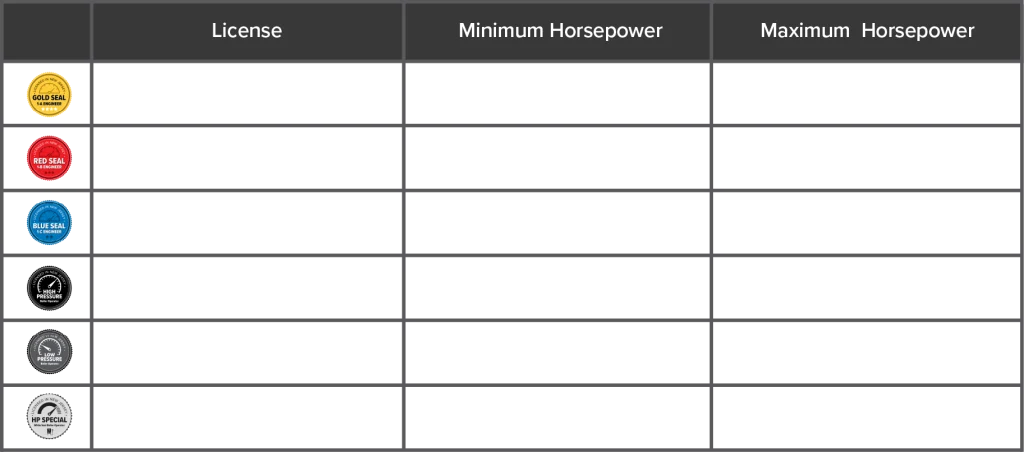
For many standard building systems, operators typically pursue either the Black Seal High Pressure license or the Black Seal Low Pressure license. These are common in facilities such as apartment complexes, schools, and commercial buildings.
Larger and more advanced boiler systems are often found in industrial and institutional settings. These require specialized credentials such as the Blue Seal, Red Seal, or Gold Seal license. Each level reflects increased horsepower thresholds, pressure requirements, and overall system complexity.
Each license level has its own minimum boiler horsepower and pressure requirements, as well as minimum experience requirements. In general, you must:
- Work for a required period of time in a facility that has qualifying boilers
- Work under the supervision of a properly licensed operator
- Log experience on equipment that matches or exceeds the license level you are seeking
- Pass the corresponding state exam
Getting Boiler Experience
One of the biggest challenges for anyone trying to become a licensed boiler operator in New Jersey is getting the required hands on experience.
To qualify for a state exam, you need supervised hours on qualifying boilers. The catch is that many facilities do not want to hire someone around those systems unless they already have a license or relevant experience. That creates a real “no experience, no job” loop for beginners.
A good Boiler Operator Training Program is designed to help break that loop. The goal is to:
- Teach you boiler fundamentals and safety
- Give you structured, supervised time on real equipment
- Help you meet the experience requirements tied to a Black Seal or other license
- Prepare you for the New Jersey exam, not just generic boiler theory
Programs that provide structured training environments with real equipment are especially valuable for aspiring boiler operators, because they replicate the kinds of situations technicians will face on the job. When evaluating your options, consider enrolling in Boiler Classes and Courses in New Jersey, which are designed to meet both the educational and practical experience requirements needed for licensure. These programs not only teach boiler operation fundamentals but also help you accumulate the supervised hours required for New Jersey’s Black Seal license and other state certifications.
Average Boiler Operator Salary
Boiler operation is one of those trades where the investment in training often pays off quickly. Once licensed, operators can move into roles that carry strong salaries and clear paths for advancement.
Here is a sample of average salaries across related boiler and plant operation roles:
| Job Title | Average Salary |
|---|---|
| Power Plant Manager | $156,000 |
| Operations Supervisor | $126,000 |
| Power Generation Engineer | $94,500 |
| Supervisor Control Room Operator | $87,000 |
| Control Room (Plant) Operator | $73,500 |
| Steam Boiler and Refrigeration Operator | $64,300 |
| Entry Level Boiler and Stationary Engineer | $59,390 |
These salary ranges are based on Indeed average annual salary estimates for boiler and plant operations roles at the time of writing. Actual pay depends on location, experience, license level, and the type of facility you work in.
How to Choose a Boiler School
Once you decide to pursue boiler operations, the next step is choosing the right boiler operator school to get your training. In a state like New Jersey, where licensing is mandatory, your choice of school has a direct impact on how quickly and smoothly you can:
- Gain the knowledge you need
- Get the experience you need
- Qualify for your state license
- Move into a job that uses it
Below are the key factors to look at when comparing boiler programs.
Boiler School Tuition
Boiler training is an investment, so tuition is an important factor. Costs vary widely between schools. Larger national trade schools often charge more, while smaller, specialized programs can sometimes deliver better training for less.
Higher tuition does not automatically mean higher quality. When you compare programs, focus on value:
- Does the curriculum prepare you for the New Jersey license exam you care about?
- Does the program help you earn required experience, not just classroom hours?
- Are there real outcomes in terms of graduates getting licensed and employed?
A good program will give you the skills, experience, and support you need to start working without loading you down with unnecessary debt.
Boiler School Schedule
Many boiler students have jobs, families, or other commitments. School cannot always be your only focus, and a good program should recognize that.
When you review boiler schools, consider:
- Are there evening or weekend class options?
- Are there any hybrid or online options for theory, while keeping hands on work in person?
- Can you choose from multiple hands-on lab times or locations?
- What happens if you have to miss a session?
The more flexible and realistic the schedule, the easier it is to stay on track, complete the program, and move on to licensing.
Real World Training
Boiler operation cannot be learned from slides alone. Real understanding comes from:
- Working on live or training boilers
- Taking readings, logging data, and adjusting controls
- Seeing how different types of boilers behave under varying loads
- Troubleshooting actual faults and issues
A strong Boiler Training Program should:
- Give you hands on exposure to multiple boiler types and setups
- Use training that mirrors real world plant environments
- Emphasize safety, code compliance, and operational checks
The more realistic the training environment, the faster you will become comfortable and confident when you transition into a working plant.
Student To Teacher Ratio
Boiler systems are complex enough that you need time with your instructors. If a program has very large classes and limited instructors, it is easy to get left behind.
Ask each school:
- How many students are typically in each class or lab?
- How many instructors are present during hands on training?
Smaller student to teacher ratios generally mean:
- More one on one guidance
- Faster feedback when you are learning a new skill
- A better chance to build relationships and references that help with job searches
Reputation and History
Reputation matters, especially in a specialized field like boiler operations. When you research schools, look for:
- How long they have been training boiler operators
- Whether they have a history of preparing students for New Jersey Boiler Licenses
- Feedback from past students about the quality of training and job outcomes
A school that understands New Jersey licensing rules and is known in the industry can make your path to a boiler career much smoother.
Job Placement Support
Your goal is not just to earn a license, it is to work in boiler and plant operations. That is why job placement support is so important.
Good signs include:
- Resume help and interview prep
- Employer relationships and hiring partners
- Instructors with strong industry connections
- Guidance on which facilities match your goals and license level
The more support you get at this stage, the easier it is to turn training into a real job.
Building a Boiler Career That Lasts
Boiler and plant operations offer one of the most reliable paths to a steady, well-paying, and hands-on career in the skilled trades. With strong demand, clearly defined licensing pathways, and opportunities to grow into broader roles in plant and facility operations, it’s a field where your investment in training can pay off for decades.
The right school plays a major role in that journey. Look for programs that are aligned with New Jersey licensing requirements, emphasize real-world, hands-on training, offer flexible scheduling, and provide meaningful support as you transition into the workforce. When a school checks these boxes, it does more than teach you boiler theory, it sets you up for long-term success.
The Training Center is an accredited Boiler School in New Jersey, with over 40 years of experience helping boiler operators build successful careers. The school focuses on practical training, smaller class sizes, and clear guidance around state licensing, making it a strong choice for anyone looking to start a career as a boiler operator in NJ.